Noetics: The Study of Consciousness
Table of contents:
- The
components of consciousness
- Views of the Mind
- The nature of ordinary
consciousness
- Discrete states of
consiousness
- Stabilization of a state
of consciousness
- Induction of Altered
States
- Subsystems
- Individual
differences
- Identity States...
- Strategies
- The depth dimension of a state of
consciousness
- Higher states of consciousness
- Steps in a typical evaluation and decision-making process
The
components of consciousness:
- Attention / awareness
- Kinds of awareness
- Environmental-awareness
- Self-awareness
- Views of awareness
- Awareness is a product of the structure and content of
the
individual brain.
- Awareness is at least partially something from outside
the
workings of the brain.
- Awareness can be volitionally directed to some
extent.
- Stimuli instructors attract or capture attention /
awareness.
- The ease with which particular kinds of structures
and
contents capture attention / awareness varies with the state of
consciousness and the personality structure of the individual.
- Attention / awareness constitutes the major energy in
the
mind, as we usually experience it.
- Attention / awareness is energy...
- In the sense that structures having no effect on the
consciousness at a given time can be activated if attended to.
- In the sense that structures may draw attention /
awareness
energy automatically, habitually, as a function of personality
structure, thus keeping a kind of low-level, automated attention in
them all the time.
- In the sense that attention / awareness energy may
inhibit
particular structures from functioning.
- Structures
- We infer (from outside) the existence of a particular
structure by observing that a certain kind of input information
reliability results in specific transformed output information under
typical conditions.
- We hypothesize that structures generally continue to
exist
even when they are not active, since they operate again when
appropriate activating information is present.
- The structure forming something that has a recognizable
shape, pattern, function, and process that endure over time.
- Some structures may be so complex that we are unable to
recognize them as structures.
- A psychological structure may vary in intensity and /
or
the quality of its activity, both overall in and in terms of its
component parts, still retain its basic patterns
(Gestalt qualities) and so remain recognisably the same.
- Some structures are essentially permanent.
- Some structures are mainly or totally given by an
individual's particular developmental history; they are
created by, programmed by, learning conditioning, and enculturation
processes that the individual undergoes.
- Permanent structures create limits on, and add
qualities to
what can be done with programmable structures: the hardware puts some
constraints on what the software can be.
- Structures, for the outside investigator, be
hypothesized explanatory entities based on experiential,
behavior, or psychological data.
- Interaction of structures and attention / awareness.
- Many structures function completely independent of
attention / awareness.
- Some psychological structures require a certain amount of
attention / awareness energy in order to...
- Be formed or created in the first place (software
programming).
- Operate
- Have their functions inhibited.
- Have their structure or operation modified, and/or...
- Be destructured and dismantled.
- Attempts to stop its certain structure from operating by
trying to withhold attention energy from its may fail.
- If the structure is (at least partially) operating on
energy other than attention / awareness it may no longer be possible to
change it with the amount of attention / awareness energy we are able
to focus on it.
- Even if the structure still operates with attention /
awareness energy, complete control of this energy may be beyond our
conscious volition for one or both of the following reasons:
- The energy flow through it maybe so automatized and
overlearned, so implicit, that we simply do not know how to affect it.
- The functioning structure and may have vital (and often
unpleasant or hidden) connections with our reward and punishment
systems, so that there are secondary gains from the operation of the
structure, despite our conscious complaints.
- Since the amount of attention / awareness energy
available
at any particular time as a fixed upper limit, some decrement should be
found when too many structures draw on this energy simultaneously.
- Once a structure has been formed and its operating,
either
in isolation or an interaction with other structures, the attention /
awareness energy required for its operation can be automatically drawn
on either intermittently or continuously.
- There is a fluctuating but generally large drain on
attention / awareness energy at all times by the multitude of automated
interacting structures whose operation constitutes personality, the
normal state of consciousness.
- Interaction between structures.
- Individual structures of various kinds of properties.
- Information is fed into any structure in one or more ways
and comes out of the structure in one or more ways.
- Kinds of inputs and outputs for complex structures.
- Inputs and outputs that we can be constantly aware of
with suitable deployment of attention / awareness.
- Inputs and outputs that we cannot be consciously
aware
of
but we can make inferences about.
- Inputs and outputs that are part of feedback control
interconnections between structures, which we cannot be directly aware.
- For two structures to interact
- They must have either a direct connection between them
or
some connections mediated by other structures.
- Their input and output information must be in the same
code so information output from one makes sense to the input from the
other.
- The output signals of one structure must not be so weak
that they are below the threshold for reception by the other
structure.
- The output signals of one structure must not be so
strong
that they overload the input of the other structure.
- Two structures may be unable to interact properly if the
action of a third structure interferes with them.
- Two structures interact readily and smoothly with one
another to form a composite structure, a system whose properties are
additive properties of the individual structures, as well as Gestalt
properties unique to the combination.
- The interactional structures apply to both hardware
(biologically given) and software (cultural programmed) structures.
- Defense mechanisms can be viewed in these system terms
whose ways of controlling interaction patterns among perceptions and
psychological structures.
- Many structures using internet simultaneously with all
the above-mentioned factors facilitating or inhibiting interactions to
various degrees at various points in the total system formed.
- While the interaction of structures is affected by the
way attention / awareness energy has deployed, it is also affected by
the properties of individual structures.
Views
of the Mind:
- Conservative View
- Danger of The View
- Many experiences in various altered states of
consciousness
are inconsistent with this theory, that implicit faith in the
conservative view makes us liable to distort our perceptions of this
phenomenon.
- Parapsychological data suggests that awareness is at
least
partially outside brain functioning, the condition that leads to very
different views of human nature.
- Concepts of the conservative view
- Fixed biological hardware qualities of those
inherited In the physical makeup of the brain itself, as dictated by
the physical laws that govern reality. The fixed reality molds the
biohardware.
- Semichangeable mental software qualities are the
programmable aspects of the brain, the capacities for recording data
and building up perception evaluation, and action patterns in
accordance
with programming instructions given by the culture. The cultural
programs the software of individual and sometimes vice versa.
- Awareness as shown as an emergent quality of the brain,
and
so awareness is ultimately limited by the hardware and by particular
software programs in the brain.
- Consciousness is the individual's experience of
awareness
diffused through a tiny fraction of the structure of the brain and
nervous system.
- Radical View
- Concepts of the radical View.
- Awareness is soon as something that comes from outside
the
structure of the physical brain, as well as something influenced by the
structure of the brain (thus given consciousness) in the cultural
programming.
- Physical reality is not completely fixed in today, but
something that may actually be safe in some fundamental manner by the
individual's beliefs about it. Not perceptions of reality, but of the
actual structure of reality.
- Mental software and consciousness is the same as the
conservative view.
- Awareness is only a function of the brain is a hindrance
because...
- Psychology deals more and more with the phenomena of
altered states of consciousness, it will more and more have to deal
with phenomena that does not sit well in a conceptual scheme that says
awareness is only a product of the brain.
- The existence of first-class scientific data to suggest
that awareness may be something other than the product of the brain.
The
nature of ordinary
consciousness:
- Ordinary state of consciousness is not natural or given.
- Most of our lives are spent in consensus reality made by
our culture.
- Consciousness, not our sense organs, is really our origin
of perception, and one way to begin to see the arbitrariness of our
consciousness is to apply the assumption that order of consciousness is
somehow natural or given to the perceptual situation.
- Most of us deal with this agreement by simply assuming that
those who disagree with us or wrong, but our own perceptions and
consciousness are the standard of normality and righteousness, and that
other people cannot observe or think well and / or are lying, evil, or
mentally ill.
- Perception can be highly selective and filtered.
- Unknown information passes right through the mind without
making a match.
- Enculturation
- The culture trains in you what is "good", "holy",
"natural", and
what is "bad", "evil", "unnatural." They reward you for the good and
punish
you for the bad.
- The culture you live in thinks its culture is the best,
and
other cultures are bad.
- Stages of culturation
- Infancy
- A person's innate learning capacity may be highest of
all
in infancy, for the infant has to learn to construct the consensus
reality of his culture.
- The structuring / programming of our consciousness
that
takes
place in early infancy is probably the most persistent and most
implicit of all the programming and learning, for at that time we have
no other framework to compare it with.
- Childhood
- Attained a basic membership in the consensus reality
of
his culture but not complete his consciousness is shaped to fit
consensus reality is through the medium of language.
- Adolescence
- Very much a member of the consensus reality of his
culture:
his ordinary state of consciousness is well adapted to fit
into it.
- A fair degree of control over his physical
environment.
- Adulthood
- Full-fledged members of the consensus reality: they
both
maintain it through their interaction with their peers and are shaped
by and by parts of it.
- Because of the power over physical reality given them
by
their consensus reality state of consciousness, adults are the most
free; yet, because they are the most thoroughly indoctrinated in
consensus reality, they are the most bound.
- Senescence
- Potentials deteriorating, breakdown may alter the
structure.
- To old to participate actively in the affairs of his
culture.
- The complexity of consciousness.
- Mental
- Cognitive experience
- Philosophies and world views
- (Implicit) beliefs
- Perceptual learning, conditionings, language structure,
and
a priori categories.
- Emotional
- Emotional experience
- Likes and dislikes
- Defense mechanisms in unconscious complexes.
- Pleasure-pain conditioning and instincts.
- Bodily
- Bodily experience
- Complex skills and style of movement.
- Chronic muscle sets and posture.
- Reflexes, instincts, and simple motor patterns.
- Combination of one or two
Discrete
states of
consiousness:
- Mapping experiences
- Types of consciousness
- Ordinary consciousness
- Low ability to hallucinate.
- High rationality
- REM dreaming
- High ability to hallucinate.
- Low rationality
- Lucid dreaming
- High ability to hallucinate.
- High rationality
- Definition
- A unique configuration or system of psychological
structures or subsystems.
- To understand a discrete states of consciousness, we must
grasp the nature of the parts, psychological o structures/subsystems
that compose it, and we must take into account the Gestalt properties
that arise from the overall system-- that properties that
aren't an obvious result of their functioning of the parts.
- Discreteness of states of consciousness
- It's immediate experiential basis is usually Gestalt
pattern recognition.
- There has been little or no mapping of the transition
from
the baseline state of consciousness to the altered state.
- Ego states during sleep.
- Intact ego state
- Filtered consensus reality well, and there was little
or no
feelings of loss of reality contact.
- Destructuralized ego state
- Content was bizarre.
- Reality contact was impaired or lost.
- Restructuralized ego state
- Contact with reality was lost.
- Contact was plausible by consensus reality standards.
- Many of the structures we deal with in our conscious,
as
constructed in our personal growth, or not ultimate structures but
compound ones peculiar to our culture, personality, and belief systems.
Stabilization
of a state
of consciousness:
- Loading stabilization- keeping a person's conscious busy
with desired types of activities so that too little
(attention/awareness) energy is left over to allow disruption of the
system's operation.
- Types of loadings
- Physical laws
- Your body (and your internalized body image)
- Body movement
- Thinking
- Negative feedback stabilization- such as anxiety or fear.
- Positive feedback stabilization
- Limiting stabilization
- Tranquilizing drugs
- Emotions
Induction
of Altered
States:
- General principles
- Induction operations
- Disruptive enough stabilizing processes to a great
enough
extent that the baseline pattern of consciousness cannot maintain its
integrity.
- Apply patterning forces stimuli that then pushes
disrupted
psychological functioning toward the new pattern of the desired altered
state of consciousness.
- Steps in the induction process.
- Apply disruptive forces and patterning forces.
- Apply just patterning forces until discrete state of
consciousness is reached.
- Going to sleep.
- Inducing hypnosis.
- The hypnotist tells you to sit or lie comfortably, so you
do not have to exert any effort to maintain your bodily position, and
telling you not to move and to relax your body so much as possible.
- The hypnotist commonly tells you to listen only to his
voice and to ignore other thoughts or sensations that come into your
mind.
- You should not think about what the hypnotist is saying,
but listen to it passively.
- Focus your attention on some particular thing in addition
to the hypnotist's voice.
- The hypnotist commonly suggests to you that you are
feeling
sleepy or drowsy.
- As well as suggesting sleep, the hypnotist often further
indicated that this sleep is not quite the same as real sleep because
you will still hear him.
- Once you appear passive and relaxed, most hypnotic
procedures go on to simple motor suggestions, such as having you
hold an arm horizontally out in front of you and telling you it is
getting heavy.
- The hypnotic state.
- Quiet mind
- Most of the structures are inactive.
- Many of the psychological subsystems aren't actively
functioning.
- Greatly enhanced suggestibility.
- Greater mobility of attention/awareness.
- Meditation and meditative states.
- Concentration meditation.
- Put all your attention on some particular thing. This
can
be internally or externally.
- If the mind wanders away from this focus the meditator
is
to bring it back gently to this focus, and not allow it to be
distracted.
- State resulting from concentration meditation.
- Voidness, blankness, nothingness.
- Temporary non-functioning of all psychological
functions.
- Opening-up
meditation.
- Helps you achieve full sensitivity to and awareness of
whatever happens to you, to be a conscious observer observing what is
happening to you about being caught up in your reactions to it.
- Expressive
meditation.
Subsystems:
- Exteroception- the eyes, ears, nose, taste organs, and
touch organs.
- Active organ- normally engage in active scanning of the
envrionment.
- Limited responsiveness.
- Some voluntary control over the input to your
exteroception
sense.
- Input from the environment that, while varying, remains
within a learned, anticiated range acts as a source of leading
stabilization.
- Redirection of sensory input to a level as near zero as
possible is a potent technique for incuding discrete altered state of
consciousness.
- Changing the patterning of input to the exteroceptions,
and
the subsequent processing of the information in Input-Processing, can
also be a major way of altering consciousness.
- Overloading the exteroceptions is another way of inducing
discrete altered state of consciousness.
- Interoception- senses that tells us what is going on inside
our bodies- the position of our limbs, the degree of muscle tension,
how our limbs are moving, pressure of our intestines, body temperature.
- Interoception signals not normally in our awareness can
be
put in our awareness by turning our attention / awareness to them.
- We can also control interception input by doing various
things to our bodies.
- The pattern of input from our interoceptions can be
subsumed under a
useful psychological concept, the body image.
- The body image can be very rigid and may or may not so
much
correspondence to the actual body contours and what actually goes on in
the body.
- Enormous changes can take place in interoception.
- Changing your body image is a common technique for
inducing
discreet altered states of consciousness.
- Immobilizing the body in a relaxed position in a major
way
of causing the output from its reception to face and, consequently,
causing the body image either to face or to change, but it is no longer
stabilized by actual input from the interoceptions.
- Overloading interoceptions is an important technique for
altering consciousness.
- Patterning interoception input in unusual
fashions
is another way of inducing discreet altered states of consciousness.
- Input processing- subsystem consists of a complex,
interlocking series of totally automatic processes that compares
incoming data against previously learned material stored in memory,
rejects much of the data as irrelevant, selects some of them important
enough to deserve further processing, transforms and abstracts these
important data, and passes this abstraction along to awareness.
- Input processing is totally automatic.
- Input processing is a learned behavior, probably the most
complex a human being has to acquire.
- Variations in input processing that are related to
difference withing consenseus reality.
- Fixed properties of perceptual organization may change in
various discrete altered states of consciousness as input processing
changes.
- Illusions and halluncinations, frequently reported in
discrete altered states of consciousness, represent important changes
in input processing.
- Another type of variation that can occur in input
processing in discrete altered states of consciousness is the partial
or total blocking of input from exteroceptions or interoceptions.
- When input is completely blocked in input processing,
there
may or may not be a substitution of other input.
- Reported in discrete altered states of consciousness is
an
experience of feeling more in touch with the actual machinery of input
processing, gaining more insight or direct experience of how
abstracting processes work.
- Memory- concerned with information storage, with
containing
residue of past experiences that are drawn upon in the present.
- Short term memory - special memory process that holds
information about
sensory input and internal processes for a few seconds at the most.
- Medium term memory - storage from minutes to a day or
so.
- Long term memory - semi-permanent structure changes
that
allow you to
recall things experienced and learned a long time ago.
- Most important aspect of memory subsystem functions in
various discreet
altered states of consciousness is the phenomena of state-specific
memory.
- Subconscious - mental processes or phenomena that occurs
outside conscious awareness in that ordinarily cannot become conscious.
- Includes sexual and aggressive instincts and their
subliminations.
- Includes creative processes, the kinds of things we
vaguely
call
intuition and hunches, tender and loving feelings that may be just as
inhibited in their expression as sexually aggressive ones, and other
factors influencing conscious behavior.
- Includes kinds of thinking that are now called right
hemisphere
modalities of thinking.
- Evaluation and decision-making- those intellectual,
cognitive processes with which we deliberately evaluate the meaning of
things and decide what to do about them.
- Logic is a self-contained, arbitrary system.
- Much of what passes as rationality in our ordinary
discrete
states of consciousness is in fact rationalization.
- In the ordinary discrete state of consciousness, the
operation of the evaluation and decision-making subsystem is often
hyperactive to the point of constituting noise--noise in the sense that
the over investment of attention/awareness energy in this process
lowers the ability to notice and deal with other sources of relevant
information.
- All the above relatively quantative variations in the
functioning of the evaluation and decision-making subsystem may be
exaggerated in various discrete states of consciousness.
- The substitution of a different logic from one ordinarily
used in your base state of consciousness is a qualitative variation in
various discrete states of consciousness.
- In the ordinary discrete state of consciousness, we are
intolerant of contradictions in logic; in a discrete state of
consciousness, tolerance for contradictions may be much higher.
- There apparently exists two discrete modes of cognition
associated with the functioning of the left anad right cerebral
hemispheres, respectively.
- In the ordinary discrete state of consciousness,
constant,
repetitious thinking absorbs a great deal of attention/awareness energy
and acts as a form of load stabilization.
- Ordinarily evaluation and decision-making activity
consists of a sequential progression from one thought to another.
- In some of the more stable discrete states of
consciousness, like hypnosis or dreaming, the rules for association may
be systematically changed.
- Emotions- feelings that can be named but not easily
defined. Such as grief, fear, joy, surprise, yearning, anger, but that
we
define inadequately in terms of words.
- The emotions subsystem is, in one sense, the most
important
subsystem, for it can exert tremendous influence.
- The Western culture is strongly characterized by poor
volitional control over the emotions subsystem in the ordinary
discrete state of consciousness.
- In addition to changes in the degree of control over
emotions, the intensity of emotions themselves may also change in
discrete alternate states of consciousness.
- In some discrete alternate states of consciousness new
emotions appear, emotions that are never present in the ordinary
discrete state of consciousness.
- Space/time sense- experiental constructs that we have used
to organize sensory stimuli coming to us.
- In the ordinary discrete state of consciousness there is
a
small amount of variation in space/time sense.
- Variations in the apparent rate of time flow may be much
larger
in some discrete altered states of consciousness but not too
much.
- Reported from some discrete altered states of
consciousness is that the direction of flow of time seems to change.
- A rewarding discrete altered state of consciousness
experience
is an increased focus on the present moment, a greatly increased
here-and-nowness.
- The experience of timlessness, of the feeling that any
kind of temporal framework for an experience as meaningless as reported
in various discrete Altered States of consciousness.
- Deja Vu is a time experience and occasionally happens in
the ordinary discrete state of consciousness it may actually represent
a momentary transition into a discrete altered state of consciousness
and happens more frequently in discrete altered states of consciousness.
- The quantitative variations in space perception that
occur
in the ordinary discrete state of consciousness may occur in greatly
increase
form of discrete altered states of consciousness.
- Another discrete altered states off
consciousness-associated
spatial change is loss of the spatial framework as a source of
orientation.
- We ordinarily think of space is empty, but in discrete
altered states of consciousness space is sometimes perceived as having
a more solid quality, is being filled with "vibrations" or "energy,"
rather than as being empty.
- Sense of identity- function is to attach a "this is me"
quality to certain aspects of experiences to certain information in
consciousness, and thus to create the sense of an ego.
- Any item of information to which the "this is me" quality
is attached acquired considerable extra potency and so may arouse
strong emoitons and otherwise control attention/awareness energy.
- At any given time only some of the contents of awareness
are modulated by the ego quality.
- Another major function of the sense of identity subsystem
in
the exact opposite of its usual function: a denial of the sense of self
to certain structures.
- The functioning of the sense of identity subsystem is
highly
variable in the ordinary discrete state of consciousness, much more
variable than we are ordinary aware.
- Each person has a number of relatively permanent
identifications, well-defined experiential and behavioral repertoires
that he thinks of himself.
- One of the person's most constant, semi-permanent
identifications is with his own body, more precisely, with his body
image, the abstract of the data from its body is mediated through the
exteroception, interoception, and input processing subsystems.
- On the basis of this massive transient and semi-permanent
identifications, with various degrees of compartmentalization, each of
us believes in something he called his ego or self.
- Ego is characterized as a continuity and consistency
of functioning to which we attach special importance, that which does
not have these reality of a sollid thing somewhere, which is only a
pattern of operation that disappears under close scrutiny.
- Reports from the discrete states of consciousness
indicate that the sense of ego can be disengaged from a wide variety of
kinds of information and situations to which it is normally attached.
- Motor output- consists of those structures by which we
physically affect the external world and our own bodies.
- Two kinds of inputs control motor output
- Input from the evaulation and decision making
subsystem,
conscious decisions to do or not to do something.
- Input from a series of controling that by passes the
evaluation and decision making subsystem.
- Reflexes
- Emotional reactions
- Direct control of motor output from the subconscious
subsystem.
- Motor output operates with almost constant feedback
control.
- Many voluntary movements are quite unconscious in terms
of
their details.
- Deautomatization of motor actions is another sort of
altered awareness of motor output that can occur in a discrete altered
state of consciousness.
- In a discrete altered state of consciousness the
subconscious subsystem may control the motor output subsystem or parts
of it.
Individual
differences:
- Psychologically, each of us assume that his own mind is an
example of a "normal" mind and then projects his own experiences on
to other people, iaware of how much projecting he is doing.
- On those occasions when we do recognize great
differences in the mental functioning of others, we are tempted to
label the differences weird or abnormal or pathological.
- In addition to the large individual differences that may
exist among people we think are all in the same discrete state of
consciousness, there are important individual differences among
people's abilities to transit from one discrete state of consciousness
to another.
Identity
States...
- ... have an overall pattern of functioning, a Gestalt,
which gives
it a system identity and distinguishes it from other identity states.
- ... are composed of structures / subsystems, psychological
functions,
skills, memories.
- ... posses unique properties not present in other identity
states.
- ... presumably has some stabilizing processes, although
apparently
fewer than the ordinary discrete state of consciousness as a whole,
since identity states can change so rapidly.
- ... functions as a tool for coping with the world, with
varying degrees
of effectiveness.
- ...require an induction process to transit from one
identity state to
another, a requisite stimulus to bring on a new identity state.
- Identity states are almost never identified as discrete
states of consciousness in ordinary people because...
- ...each person has a large repertoire of these identity
states and transits between one and another of them extremely readily
practically instantly.
- ...all these identity states share much psychological
functioning in common, such as speaking English, responding to the same
proper name, wearing the same sets of clothes.
- ...all a person's ordinarily used identity states share
in his culturally defined consensus reality.
- ...a person's identification is ordinarily very high,
complete, with each of these identity states.
- ...identity states are driven by needs, fears,
attachments, defensive maneuvers coping mechanisms, and this highly
charges quality of an identity state makes it unlikely that the person
involved will be engaged in self-observation.
- ...many identity states have, as a central focus,
emotional needs and drives that are socially unacceptable or only
partially acceptable.
Strategies:
- Basic predictive operations
- Observe the properties of structures / subsystems as well
as you can from the current state of knowledge.
- Organize the observations to make better theoretical
models
of the structures / subsystems.
- Predict, on the basis of the models, how those structures
/
subsystems can and cannot interact with each other under various
conditions.
- You can test these predictions by looking for or
attempting
to create a discrete state of consciousness that fit or do not fit
these improved structure / subsystem models and seeing how well the
models work.
- Sequential strategies in studying discrete states of
consciousness
- The general experiential, behavior or
physiological components of a rough concept of a particular discrete
altered state of consciousness are mapped.
- The experiential space of varying individuals is
mapped to
determine whether their experiences show the distinctive clusterings
and patternings that constitute a discrete states of consciousness.
- Map various discrete states of consciousness of
particular
individuals in detail.
- Even more detailed studies can be done on the nature of a
particular discrete states and the structures / subsystems comprising
them.
The
depth dimension of a state of consciousness:
- Relation of depth to intensity
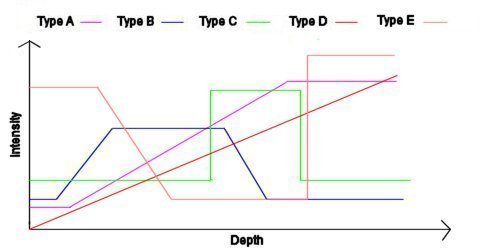
- Self-reports of depths
- The Extended North Carolina Scale
- Zero - normal, waking state
- 1 - 12 - relaxed and detached state
- 20 or greater- very definitely hypnotized
- 25 or greater - strong inner experiences;
dreams
or dreamlike experiences
- 30 or greater- regressing into the past; mind very quiet
- 40 or greater- very deep hypnotic state; mind perfectly
still and at peace
- William: deep hypnosis and beyond
- First effect "physical relaxation"
- Second effect "blackness" of the visual field
- Third effect "peacefulness"
- Fourth effect "awareness of environment"
- Fifth effect "sense of identity"
- Sixth affect "awareness of the joke" - the joke is that
William should engage in strange activities like deep hypnosis,
meditation; some "higher" aspects of himself is amused by all this
activity, and William himself becomes aware of this amusement.
- Seventh effect "sense of potentiality"
- Eighth effect "experimenter's identity"
- Nineth effect "rate of time passage"
- Tenth effect "feeling of oneness"
- Eleventh effect "spontaneous mental activity"
- Twelve effect "awareness of his own breathing"
Higher
states of consciousness:
- Higher and lower discrete states of consciousness
- Orthodox Western
- Primary value- complete rationality, adherence to the
logic
and values our culture believes are true.
- Ordinary rationality is occasionally neurotic.
- Dreaming is a lower discrete state of consciousness
because
there are many logical flaws in it and the dreamer is out of touch with
(consensus) reality.
- Psychotic states are even lower in these ways.
- Toxic psychoses (states induced by major poisonings)
are
usually the most irrational and out-of-touch states of all.
- Creative states are located between ordinary rationally
and
dreaming.
- "Hip"
- Highest states are mystical experiences.
- Creative states are next in value.
- Open or loose rationality.
- Ordinary, neurotically flawed rationality.
- Complete rationality is valued somewhere between open
and
ordinary rationality.
- Dreaming is generally considered somewhat lower than
ordinary rationality.
- Psychoses are at the bottom.
- Three explicit orderings
- Buddhist path of concentration
- Access State - hindering thoughts overcome, other
thoughts
remain. Awareness of sensory inputs and body states. Primary object of
concentration dominates thought. Feelings of rapture, happiness,
equanimity. Initial and sustained thoughts of primary object. Flashes
of light or bodily lightness. (This one and the next four following are
material states.)
- First Jhana- hindering thoughts, sensory perception,
and
awareness of painful bodily states all cease, initial and
unbroken sustained
attention to primary object of concentration. Feelings of rapture,
bliss, and one-pointedness.
- Second Jhana- Feeling of rapture, bliss,
one-pointedness.
No thought of primary object of concentration.
- Third Jhana- Feeling of bliss, one-pointedness, and
equanimity. Rapture ceases.
- 4th Jhana- equanimity and one-pointedness, all feelings
of
bodily pleasure cease.
- Fifth Jhana- consciousness of infinite space equanimity
and
one-pointedness. (This one and the rest are formless states.)
- Sixth Jhana- object infinite consciousness, equanimity
and
one-pointedness.
- 7th Jhana- awareness of no-thing-ness, equanimity and
one-pointedness.
- Eighth Jhana- neither perception nor nonperception,
equanimity and one-pointness.
- Buddhist path of insight
- Access concentration and bare insight- previous
attainment
of access concentration on path of concentration. Bare insight is an
acheivement of ablilty to notice all phenomena of mind to point where
interfering thoughts do not seriously distrub practice.
- Mindfulness- mindfulness of body function, physical
sensations, mental states, or mind objects.
- Stage of reflections- neither pleasant nor reliable.
Devoid
of self. Awareness and its objects are perceived at every moment as
distinct and separate processes.
- Pseudonirvana- clear perception of the arising and
passing of
each successive mind moment. Accompanied by various phenomena such as
brilliant light, rapturous feelings, tranquility, devotion, energy,
happiness, strong mindfulness, equanimity toward objects of
contemplation, quick and clear perception, and attachment to these
newly arisen states.
- Realization- realization of the dreadful
unsatisfactory, and wearisome nature of physical and mental phenomena.
- Effortless insight.
- Nirodh- total cessation of consciousness.
- Arica system
- -24 - neurotic states. Negative states: pain, guilt,
fear,
doing what one has to do but in the state of pain, guilt, fear.
- ±48 - the neutral bio-computer state.
Absorption and
transmission of new ideas, reception and transmission of new data and
new programs. Doing, teaching, and learning with maximum facility,
emotionally neutral. On the earth, excellent reality contact.
- +24 - all the needed programs are in the unconscious of
the
bio-computer, operating smoothly; the self is lost in pleasurable
activities that one knows best and likes to do.
- +12 - blissful, Christ-attuned state, reception of
divine
grace, cosmic love, cosmic energy, heighten bodily awareness, highest
function of bodily and planetside consciousness, being in
love.
- +6 - being a point source of consciousness, energy,
light,
and love. Astral travel and other psi phenomena. Fusion with other
entities in time.
- +3 - fusion with universal mind, union with God, being
one
of the creators of energy from the void.
Steps in a typical evaluation and decision-making process:
- A situation enters the Input Processing subsystem. A person uses
the Memory subsystem in conjuction with the Input Processing subsystem
to make an evaluation.
- If the evaulation makes only partial sense, the person seeks more information using Input Processing.
- A further evaluation is made using Memory. No action is made if the evaluation still does not make sense otherwise goto step 4.
- A valued action is made based on Memory.
- The action feeds back into Input Processing for further evaluation.
Source: States of
Consciousness (1975) by Charles T. Tart, Ph. D.