Autogenic biofeedback mechanisms
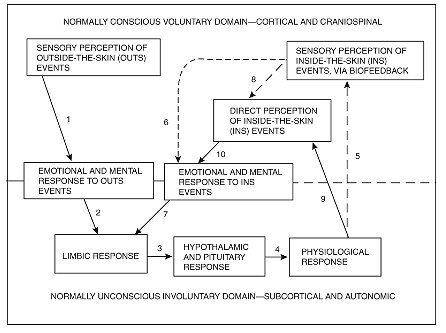
Sensory perception of OUTS events, stressful or otherwise (upper left
box), leads to a physiological response along arrows 1 to 4. If the
physiological response is "picked up" and fed back (arrow 5) to a
person who attempts to control the "behavior" of the feedback device,
then arrow 6 and 7 come into being, resulting in a "new" limbic
response. This response in turn makes a change in "signals" transmitted
along arrows 3 and 4, modifying the original physiological response. A
cybernetic loop is thus completed, and the dynamic equilibrium
(homeostasis) of the system can be brought under voluntary control.
Biofeedback practice, acting in the opposite way to drugs, increases a
person's sensitivity to INS events, and arrow 8 develops, followed by
the development of arrow 9 and 10. External feedback is eventually
unnecessary, because direct perception of INS events becomes adequate
for maintaining self-regulation skills. Physiological self-control
through classical yoga develops along the route of arrows 7-3-4-9-10-7
but for control of specific physiological and pychosomatic problems
biofeedback training seems more efficient.
Source: Principles and Practice of Stress Management, Third Edition (2007) edited by Paul M. Lehrer, Robert L. Woolfolk, and Wesley E. Sime.